Available courses

Course Description
Noon Arabic Alphabet course is designed for learners with no prior knowledge of the Arabic language. This is a beginner's Arabic language course. This course provides an introduction to Arabic phonetics and script. The pronunciation and writing of each letter is taught individually and in the context of simple words and sentences.

This course requires 120 hours to complete.

Course Learning Outcomes
 Upon completion of Noon Alphabet course, students will be able to:

● Distinguish between spoken and written Arabic letters.

● Distinguish the shape of a letter when it appears at the beginning, middle, or end of a word.

● Read short and long words and sentences.

● Write letters, words and sentences correctly.

● Learn some vocabulary and dialogs related to everyday life.

Knowledge
 This beginner's Arabic course covers the following knowledge areas:

  • Alphabets
  • Reading 
  • Writing

Assessment Overview
 The following are the course assessment criteria components:

● Online Activities (60%)

● Writing Assignments (20%)

● Quizs (20%)


Course Description

This course is designed to strengthen learners’ Arabic skills by integrating Qur’anic texts as primary sources of study. It focuses on the meanings of key religious vocabulary, the linguistic aspects of Qur’anic rulings, and the structures of sentences and pronouns. Special attention is given to the differences between Modern Standard Arabic and Qur’anic Arabic. The course combines linguistic and religious understanding, enabling students to read and analyze Qur’anic texts with clarity and accuracy.

Duration

120 hours

Learning Outcomes

By the end of this course, students will be able to: 

Understand the meanings of essential Qur’anic religious vocabulary.

Grasp the linguistic context of rulings derived from Qur’anic texts.

Differentiate between sentence structures and pronoun usage in Standard Arabic and Qur’anic Arabic.

Analyze selected Qur’anic texts from a simplified linguistic perspective.

Areas of Knowledge

The course will cover the following topics: 

Qur’anic vocabulary and its meanings.

Linguistic and religious implications of Qur’anic rulings.

Sentence structures in the Qur’an: nominal and verbal sentences.

Pronouns in Qur’anic texts and their functions.

Differences between Modern Standard Arabic and the Qur’anic Arabic.

Applied studies of selected short and medium-length Surahs.

Assessment Overview

The course assessment consists of:

  • Qur’anic text analysis activities: 60%
  • Writing and linguistic assignments: 20%
  • Written and oral exams: 20%

Course Description 

This course is designed for learners who are familiar with the Arabic alphabet but have little to no prior knowledge of the language. It focuses on real-life situations that students are likely to encounter in their daily lives. By the end of the course, learners will be able to interact with native speakers in a variety of everyday contexts, such as ordering food, discussing daily routines, asking for and giving directions, shopping, and inquiring about prices. Additionally, students will gain an introductory understanding of the fundamental structures of Modern Standard Arabic.

Suitable for foreign residents in Arab countries and students of Arabic literature and languages 

Course Duration

The course requires a total of 120 hours for completion.

Learning Outcomes

Upon successful completion of this course, students will be able to

● Initiate and respond to social interactions in simple, everyday situations

● Introduce themselves by talking about their names, professions, and friends

● Describe people by discussing their appearance and emotions

● Exchange basic information with strangers in familiar contexts

● Compose simple sentences about their personal background and interests

● Ask and answer basic questions related to daily activities, routines, and needs

● Recognize and use high-frequency vocabulary related to family, work, and social life

● Demonstrate awareness of cultural norms in Arab societies when engaging in conversations

Knowledge Areas

 This course addresses the following themes:

● Self and family

● Customs and traditions

Socialization practices

●  Marital traditions

●  Patterns of social interaction

Assessment Overview

Evaluation will be based on the following components:

● Online activities (60%)

● Writing assignments (20%)

● Tests (20%)

Course Description

This course is designed for students who are already familiar with everyday situations in Modern Standard Arabic and are ready to transition toward communication on professional topics. It aims to bridge the gap between beginner and intermediate levels. Students will work with a combination of simplified and authentic materials to prepare them for the next stage, which will rely exclusively on real materials from Arabic media. By the end of the course, students will be able to express themselves not only in everyday life situations but also in discussions on social issues that relate to the world around them.

Course duration

Completion of this course requires 120 instructional hours.

Learning Outcomes

Upon successful completion of course, students will be able to:

● Read and understand simplified texts related to issues of interest to Arab youth

● Expand their conversations beyond personal topics to discuss social issues such as emotions and social challenges

● Comprehend simple to moderately complex sentences on familiar themes

● Understand basic audio and video texts on familiar subjects

● Express personal opinions in simple language about issues concerning themselves and those around them

Knowledge

The course covers the following themes:

● Sciences 

Community

● Daily life

● Traditional markets

● Marriage

● Culture

● Planning for the Future

● Technology.

Assessment Overview

Student progress will be evaluated through the following components:

● Online activities (60%)

● Writing assignments (20%)

Tests (20%)

Course Description

This course is designed for learners who are familiar with the Arabic alphabet and possess some basic communication skills. It focuses on real-life situations that travelers and residents in the Middle East may experience. By the end of the course, students will be able to interact with native speakers in a range of everyday contexts such as ordering food, visiting tourist attractions, asking for and giving directions, shopping, and inquiring about prices.

Course duration

The course requires a total of 120 instructional hours.

Learning Outcomes

Upon successful completion of this course, students will be able to:

● Engage in basic social interactions and request essential information while demonstrating awareness of cultural norms in Arab societies

● Talk about themselves, their education, and their family in conversations with native speakers

● Understand simple written texts on familiar and everyday topics

● Write short paragraphs to describe personal experiences and information

Knowledge

The course covers the following themes:

● Arab culture with a focus on food and outings

● Tourist attractions across the Middle East

● Shopping practices and vocabulary

● Employment and workplace basics

● Making and receiving phone calls

Assessment Overview

Student progress will be evaluated through the following components:

● Online activities (60%)

● Writing assignments (20%)

Tests (20%)

Course Description

This program provides a structured journey into the science of Tajweed, beginning with the essential rules of Qur’anic recitation and progressing toward advanced application. Students will develop the skills needed to recite the Qur’an accurately and beautifully, preserving its authentic pronunciation. The course combines theory, practice, and continuous recitation training across two levels.

Duration 

120 instructional hours of each level

Learning Outcomes

By the end of the program, students will be able to:

  • Recite the Qur’an with correct pronunciation by the Tajweed rules.
  • Recognize and apply articulation points (makharij) and characteristics of letters.
  • Implement the rules of nun sakinah, tanween, meem sakinah, and elongations.
  • Apply advanced rules such as ikhfa, idgham, iqlab, qalqalah, and tafkheem/tarqeeq.
  • Correctly observe rules of stopping (waqf) and starting (ibtida’) in recitation.
  • Cultivate a deeper appreciation for the role of Tajweed in preserving Qur’anic meaning and sound.

Knowledge Areas

The course is divided into two levels:

Foundations

  • Introduction to Tajweed and its importance
  • Makharij (articulation points) of Arabic letters
  • Characteristics (sifat) of letters
  • Rules of nun sakinah and tanween
  • Rules of meem sakinah
  • Types of elongations (mad)
  • Basic rules of stopping and starting
  • Practical recitation of selected short surahs

Advanced Applications

  • Ikhfa, idgham, and iqlab rules in depth
  • Qalqalah and its degrees
  • Tafkheem and tarqeeq of letters
  • Advanced application of mad (elongations)
  • Comprehensive rules of waqf and ibtida’
  • Rhythm and fluency in Qur’anic recitation
  • Extended recitation practice with longer surahs

Assessment Overview

Student progress will be evaluated through:

Practical recitation: 70%

Written exams: 30%

Course Description

This course is designed to develop students’ ability to use Modern Standard Arabic in professional and business contexts. It focuses on practical communication skills required in areas such as commerce, trade, negotiations, meetings, recruitment, and workplace interactions. The course introduces key vocabulary and expressions commonly used in business settings, while also emphasizing cultural aspects relevant to professional communication in the Arab world.

Duration

Completion of the course requires 120 hours.

By the end of the course, students will be able to:

● Understand and use business-related vocabulary and expressions in Arabic.

● Conduct basic business conversations such as buying, selling, and professional transactions.

● Participate in meetings and negotiations using appropriate formal language.

● Read and comprehend simplified business texts, contracts, and reports.

● Write short professional emails, messages, and business-related documents.

● Recognize cultural norms and etiquette that shape professional interactions in the Arab world.

Knowledge Areas

The course covers the following topics:

● Trade and commerce

● Buying and selling transactions

● Negotiation strategies

● Business meetings and professional etiquette

● Recruitment and job interviews

● Professions and workplace communication

● Business correspondence and emails

● Contracts and agreements

● Marketing and advertising basics

● Cross-cultural communication in business

Assessment Overview

The assessment is based on the following components:

● Online activities (60%)

● Writing tasks (20%)

● Tests (20%)

Course Description

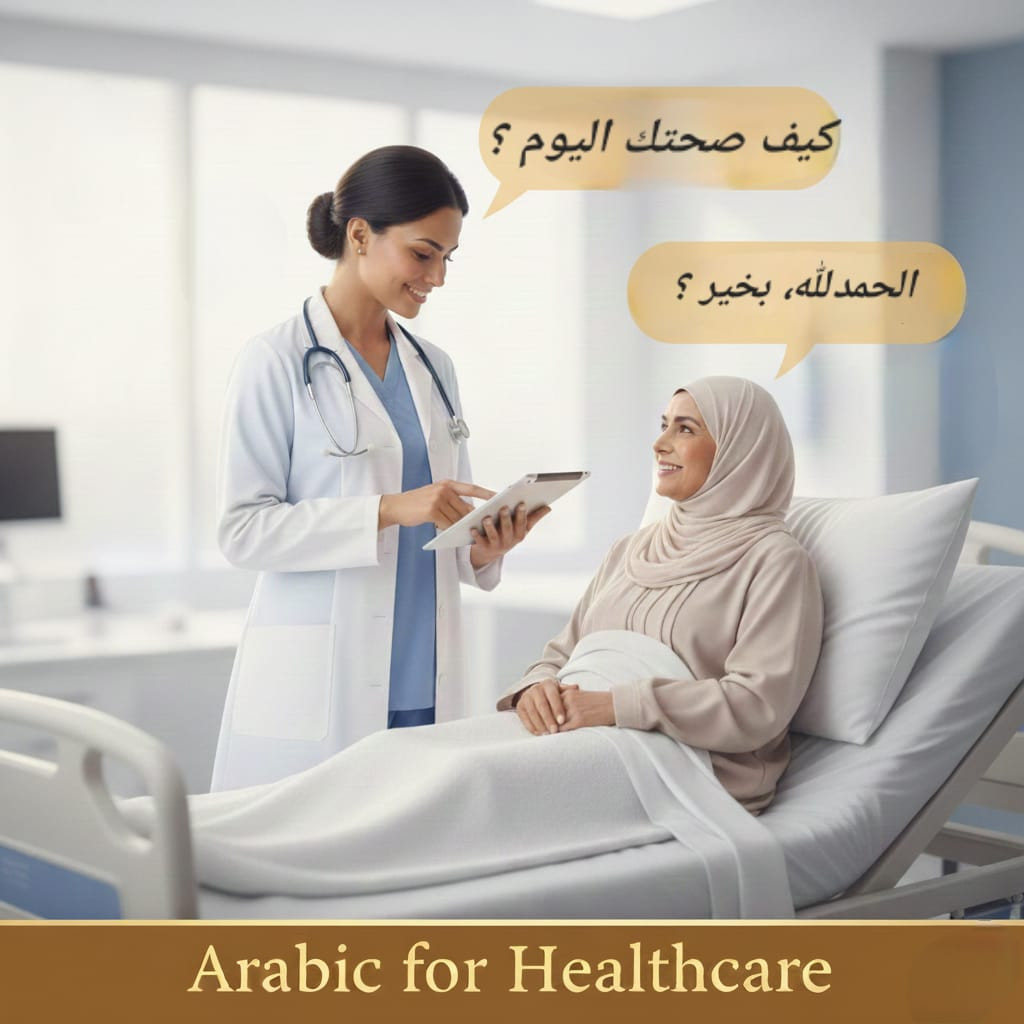
This course is designed to develop Arabic language skills in the field of healthcare and medicine. It introduces learners to essential medical vocabulary, expressions, and structures necessary for communication in clinical and hospital settings. The course covers common diseases, medical procedures, treatment methods, and the terminology of healthcare facilities and specialties. Completion of the course requires 120 contact hours.

Learning Outcomes

By the end of this course, students will be able to:

● Understand and use Arabic terminology for common diseases and their symptoms.

● Recognize and describe medical devices, equipment, and basic procedures.

● Read and understand simple medical reports, prescriptions, and patient instructions.

● Communicate basic information about diagnosis, treatment, and follow-up care.

● Identify common medical specialties and healthcare facilities in Arabic.

Knowledge Areas

The course covers the following areas:

● Common Diseases and Symptoms
 Diabetes, hypertension, asthma, influenza, heart disease, infections.

● Medical Devices and Equipment
 Stethoscope, thermometer, blood pressure monitor, MRI, X-ray, ultrasound.

● Medications and Prescriptions
 Painkillers, antibiotics, anti-inflammatory drugs, dosage instructions.

● Procedures and Treatments
 Physical examination, laboratory tests, vaccinations, surgery, therapy.

● Healthcare Specialties
 Cardiology, pediatrics, dermatology, neurology, psychiatry, surgery.

● Healthcare Facilities and Services
 Hospitals, clinics, emergency rooms, pharmacies, laboratories, rehabilitation centers.

Assessment Overview

● Online activities: 60%

● Writing assignments: 20%

● Quizzes and tests: 20%